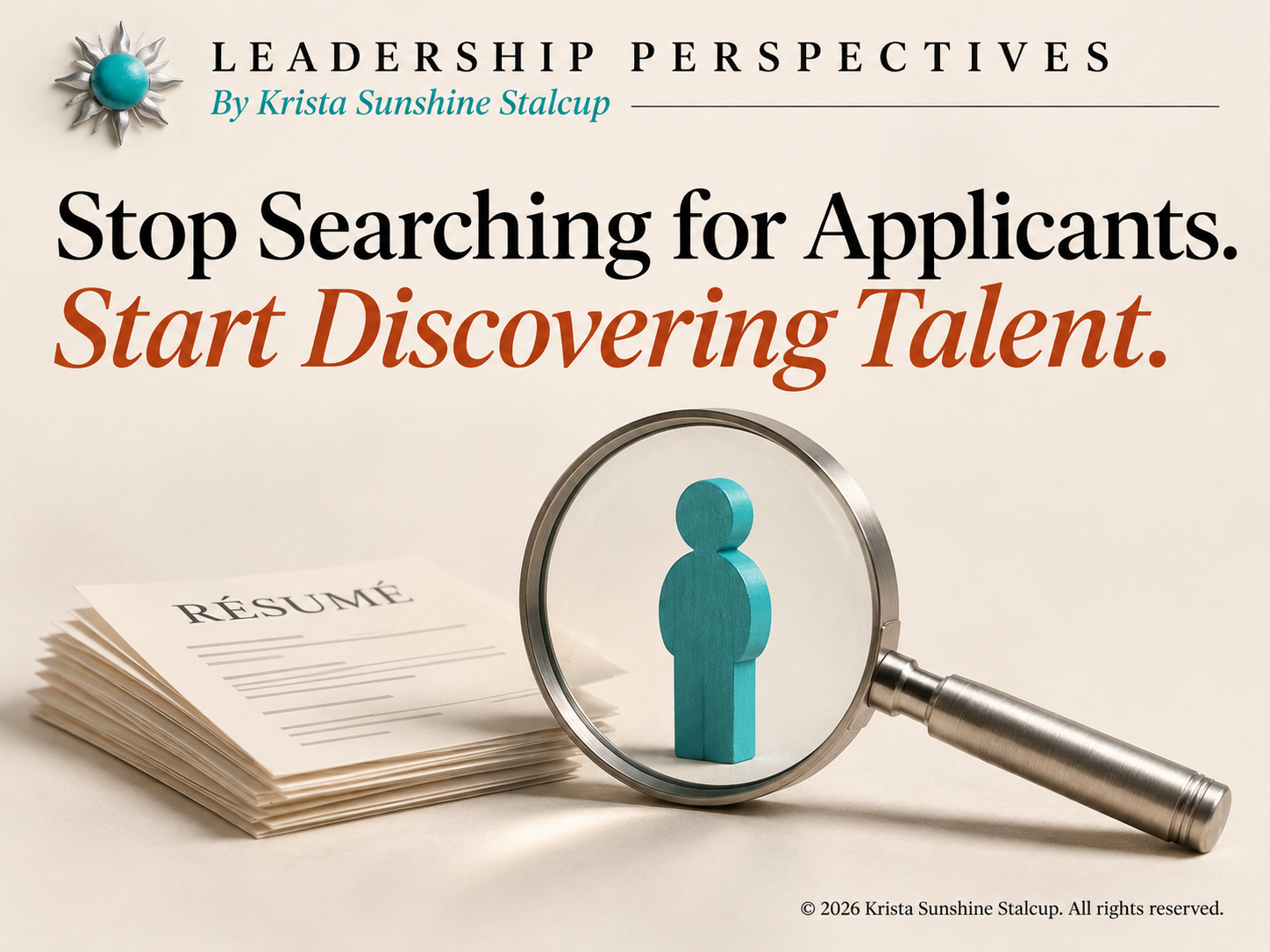
Why the future of recruitment belongs to organizations that know how to find capability, not simply filter applications.
By Krista Sunshine Stalcup | Leadership Perspectives
Something about today's recruitment process genuinely puzzles me.
We have organizations spending millions of dollars on artificial intelligence, predictive analytics, consumer research, search engine optimization and sophisticated marketing strategies to find their next customer.
Yet when it comes to finding the people responsible for leading those organizations, generating revenue, developing strategies and solving their most complex business problems, what do we do?
Post a job description and wait.
Then we implement technology to eliminate as many applicants as possible.
And when we cannot find the right person, we call it a talent shortage.
Does anyone else see the irony in this?
Having spent decades working across marketing, business development, financial services, operations, higher education and workforce development, I cannot help but look at recruitment through a different lens.
Perhaps we should stop asking why we cannot find qualified talent and start examining how we are looking for it.
Is It a Talent Shortage or a Process Failure?
According to SHRM's 2026 Talent Trends report, 68% of HR professionals experienced difficulty recruiting full-time employees. Of those experiencing difficulty, 53% said recruiting had become more challenging than the previous year.[1]
Meanwhile, experienced professionals are navigating application portals, automated assessments, screening algorithms and recruitment processes that increasingly seem disconnected from the actual responsibilities of the positions being advertised.
Employers cannot find talent.
Talent cannot get in front of employers.
And somehow, despite all the technology available to us, we continue to accept both circumstances as inevitable.
My Six Sigma background makes it difficult for me to accept that explanation without questioning the process itself.
If I were evaluating an underperforming business operation, I would not immediately conclude that the resources required to improve performance did not exist.
I would examine the process.
Where is the breakdown occurring? What are we measuring? What are we overlooking? Are our assumptions accurate? Are the people responsible for the process evaluating its effectiveness or simply following it?
Most importantly, are we solving the actual problem?
These are questions we routinely ask in operations, marketing and business development.
Why should recruitment be any different?
Congratulations. Your System Successfully Eliminated Talent.
In 2021, Harvard Business School and Accenture published Hidden Workers: Untapped Talent, estimating that approximately 27 million people in the United States represented an overlooked or underutilized workforce as of March 2020.[2]
These were not simply individuals unwilling to work. They included caregivers, veterans, people returning to the workforce, individuals who were underemployed and professionals whose backgrounds did not necessarily align with conventional screening requirements.
Then, in 2024, Harvard Business School and the Burning Glass Institute examined whether organizations announcing skills-based hiring initiatives were actually changing their hiring practices.
Their research estimated that removing degree requirements had expanded employment opportunities for fewer than one in 700 annual hires.[3]
Think about that for a moment.
Organizations changed what they said they were looking for, but many did not meaningfully change how they made hiring decisions.
We can modify job descriptions, introduce new technology, develop sophisticated dashboards and proudly announce organizational initiatives.
But if the outcome remains fundamentally unchanged, what have we actually accomplished?
Technology should improve a process, not provide a more sophisticated justification for its failures.
An applicant tracking system can successfully process thousands of applications. It can organize information, identify keywords and eliminate individuals who do not meet predetermined criteria.
Those functions serve a purpose.
But how many organizations are evaluating the quality of the talent their systems eliminate?
A candidate who never makes it through the proverbial front door will never have an opportunity to demonstrate what they could have contributed.
And the organization may never know what it missed.
Stop Looking for a Job Title. Start Looking for a Solution.
If I were advising a CEO on a business challenge, I would encourage them to approach talent acquisition the same way they approach any other strategic business initiative.
Start with the problem.
Are you struggling to generate revenue? Is your organization experiencing operational inefficiencies? Are employees disengaged? Is your leadership team unable to execute its strategy? Are departments operating in silos? Is your organization struggling to adapt to emerging technology?
Now ask yourself who has successfully addressed those problems.
Notice that I did not begin with a job title, an industry or an arbitrary number of years performing the same function.
I began with the desired outcome.
There is a substantial difference between someone who has occupied a position for ten years and someone who has spent ten years identifying problems, challenging assumptions, developing strategies and improving business performance.
One describes tenure.
The other describes capability.
Throughout my own career, I have moved between industries that, on paper, might appear to have very little in common.
Financial services. Advertising. Marketing. Higher education. Workforce development. Business operations. Entrepreneurship.
But the fundamental principles of identifying opportunities, understanding human behavior, improving processes, developing people and producing measurable results have remained remarkably consistent.
The industry changes. The terminology changes. The technology changes.
The ability to think critically, adapt, lead and execute is transferable.
Unfortunately, traditional recruitment does not always recognize that distinction.
We Have the Technology. Do We Have the Imagination?
I find the evolution of technology fascinating, particularly because I have experienced so much of it firsthand.
I remember BASIC, Turbo Pascal, DOS and working with systems that would probably leave some of today's technology professionals wondering how we ever accomplished anything.
Yet we did.
Every technological advancement introduced new possibilities, challenged established practices and required people to adapt.
Artificial intelligence is no different.
What interests me most about AI is not its ability to perform the tasks we already understand. It is its potential to help us discover possibilities we have not considered.
LinkedIn's advanced AI-assisted search capabilities, for example, are designed to identify nuanced qualifications that may not be explicitly listed on a professional profile, including experience resolving complex, ambiguous problems and leading cross-functional initiatives.[4]
LinkedIn's 2025 Future of Recruiting research also found that companies using the most skills-based searches were 12% more likely to make a quality hire, according to its platform data.[5]
That does not mean AI automatically makes better hiring decisions.
It means we have an opportunity to ask better questions.
Imagine a CEO sitting down and conducting an AI-assisted talent search:
Find me someone who has successfully built a revenue-generating business operation from the ground up.
Find me a leader who has transformed an underperforming department and produced measurable results.
Find me someone who understands marketing, operations, technology and human behavior and knows how to integrate them.
Find me an executive capable of identifying problems we have not recognized ourselves.
Now imagine that search identifying professionals who might never have appeared in a conventional applicant pool.
That is where things become interesting.
Rather than waiting for someone to submit an application, leaders could proactively identify individuals whose experience, accomplishments and capabilities align with the actual needs of their organizations.
We already apply this philosophy to acquiring customers.
Why are we not applying it more consistently to acquiring talent?
Inbound Marketing Meets Talent Discovery
As someone with a background in marketing and business development, I have been thinking about the future of professional discoverability from a slightly different perspective.
Businesses understand the importance of search engine optimization, brand positioning, authority, differentiation and visibility.
We have developed entire marketing disciplines around ensuring that when someone searches for a solution to a problem, the appropriate business can be discovered.
What happens when we apply those same principles to professional talent?
Search Engine Optimization (SEO), Artificial Intelligence Optimization (AIO), Generative Engine Optimization (GEO) and Answer Engine Optimization (AEO) are increasingly relevant to how information is discovered.
And information about professional capabilities is still information.
A résumé tells someone where you worked, what responsibilities you held and, hopefully, what you accomplished.
What it cannot always communicate is how you think.
How you identify problems.
How you develop strategies.
How you respond when things do not go according to plan.
How you integrate knowledge from different industries.
How you turn an idea into a measurable business outcome.
Those are the things I want to understand when evaluating someone for a leadership position.
They are also the things professionals can begin documenting through executive portfolios, case studies, original articles, operating methodologies, professional recommendations and supporting evidence.
Google's guidance for generative AI search continues to emphasize original, useful content and foundational SEO practices.[6] OpenAI also provides guidance for making publicly available websites accessible to ChatGPT search.[7]
Neither guarantees that a particular professional will be discovered or recommended. Recruiting platforms also have different access to information.
But the possibilities deserve our attention.
I have been developing what I refer to as inbound talent discovery, applying established marketing principles to an emerging approach to professional visibility and recruitment.
Instead of exclusively looking for opportunities, what if professionals developed a credible body of work that allowed opportunities to find them?
The objective is not simply to appear when someone searches your name.
The objective is to appear when someone searches for the problems you know how to solve.
I Am Putting That Theory Into Practice
Over the past several months, I have been developing my own executive portfolio.
Not an expanded résumé. Not a collection of buzzwords. Not another professional page telling people I am a strategic thinker, an innovative leader or a results-oriented executive.
I wanted to demonstrate those things.
I wanted someone to be able to explore my accomplishments, understand my approach to leadership, examine the evidence supporting my professional experience and see how I apply emerging technology to actual business challenges.
More importantly, I wanted to create something that communicates capabilities that might otherwise be lost in a traditional recruitment process.
Do I expect every recruiter or hiring manager to take the time to explore it?
No.
Do I expect artificial intelligence to immediately start recommending me to CEOs?
Of course not.
But I do believe professional discovery is evolving, and I would rather prepare for that evolution than wait for it to become standard practice.
There is also something strategically valuable about applying a concept to yourself before recommending it to someone else.
It is one thing to discuss AI integration, digital transformation and innovative marketing strategies.
It is another thing to actually implement them, evaluate their effectiveness, identify their limitations and improve upon them.
That is where theoretical knowledge becomes practical experience.
How I Would Redesign the Recruitment Process
If organizations genuinely want to improve how they discover talent, I would start with five organizational changes.
1. Define the business problem before defining the position.
What specifically does the organization need accomplished? How will success be measured? What capabilities are necessary to achieve that outcome?
2. Separate experience from capability.
Previous job titles, industry experience and tenure provide context, but they should not automatically outweigh demonstrated accomplishments, transferable skills and the ability to adapt.
3. Actively look for talent.
Do not rely exclusively on individuals who happen to see a job posting and successfully navigate the application process. Expand the search through professional networks, referrals, industry publications, public professional portfolios and AI-assisted sourcing.
4. Bring human judgment back into the equation.
Use technology to identify possibilities, not to eliminate the responsibility of having meaningful conversations. Verify accomplishments. Ask thoughtful questions. Explore how someone thinks and approaches problems.
5. Measure the effectiveness of hiring decisions.
How many organizations measure time-to-fill and cost-per-hire but fail to adequately examine whether their hiring decisions actually improved organizational performance?
I would also want to understand retention, employee performance, leadership effectiveness, candidate experience and whether the original business objective was achieved.
Filling a position is not necessarily the same thing as solving a problem.
Let's Not Create Another Barrier
There is, however, another side to this conversation that deserves equal attention.
A professional who has an impressive digital presence is not automatically more capable than someone who does not.
Not everyone has access to the same technology, resources, professional networks or opportunities to publicly demonstrate their accomplishments.
Some of the most knowledgeable professionals have spent their careers working with confidential information that cannot be published.
Others simply do not enjoy promoting themselves.
That does not diminish their capabilities.
Artificial intelligence can also perpetuate historical biases, make inaccurate assumptions and introduce new forms of exclusion. The U.S. Department of Justice has already provided guidance addressing disability discrimination associated with AI-enabled hiring technology.[8]
We cannot claim to be expanding access to talent while creating another arbitrary barrier that determines who deserves consideration.
A professional portfolio should be an additional opportunity to demonstrate capability, not another mandatory qualification.
AI should broaden discovery. Human judgment should evaluate the evidence. Organizational leadership should remain accountable for the decisions.
The Real Competitive Advantage
Throughout my career, I have often found that competitive advantages are not necessarily created by having access to something nobody else possesses.
Sometimes, they are created by recognizing the value of something everyone else has overlooked.
Think about the implications of that principle in recruitment.
What happens when one organization recognizes the potential of an experienced professional its competitors have repeatedly screened out?
What happens when an organization hires someone capable of connecting disciplines that have traditionally operated independently?
What happens when a CEO identifies a leader who brings an entirely different perspective to a problem the existing organization has been unable to solve?
That is not simply recruitment.
That is a strategic competitive advantage.
And it requires something no software platform can provide on its own.
Curiosity.
The willingness to question established practices, reconsider assumptions and recognize that the most valuable person for a particular opportunity may not resemble the person we originally imagined.
A Birthday Reflection
As I celebrate another birthday, I find myself reflecting less on how long I have been working and more on how much has changed throughout my professional life.
I have watched technology evolve, industries transform, business models disappear and new opportunities emerge that we could not have imagined when I began my career.
What has remained consistent is my curiosity.
I still want to understand how things work, why they fail, how they can be improved and what happens when we challenge the way things have always been done.
That is why I find this particular moment in the evolution of technology and recruitment so fascinating.
We have access to extraordinary capabilities. We can analyze information, identify patterns, discover relationships and explore possibilities at a scale that was previously unimaginable.
But having access to intelligent technology does not necessarily mean we are using it intelligently.
The responsibility to think critically still belongs to us.
And perhaps the future of recruitment will depend less on developing increasingly sophisticated methods of evaluating applicants and more on developing increasingly intelligent methods of discovering human potential.
The talent may already exist.
The experience may already exist.
The solutions to your organization's problems may already exist.
The question is whether you are looking in the right places, asking the right questions and paying enough attention to recognize them.
Stop searching for applicants. Start discovering talent.
Research and References
[1] SHRM. (2026). 2026 Talent Trends.
https://www.shrm.org/topics-tools/research/2026-talent-trends
[2] Harvard Business School and Accenture. (2021). Hidden Workers: Untapped Talent.
[3] Sigelman, M., Fuller, J., & Martin, A. (2024). Skills-Based Hiring: The Long Road from Pronouncements to Practice. Harvard Business School and the Burning Glass Institute.
[4] LinkedIn. Advanced AI Search in Recruiter.
https://www.linkedin.com/help/recruiter/answer/a9655028
[5] LinkedIn. (2025). The Future of Recruiting.
https://www.linkedin.com/business/talent/blog/talent-acquisition/future-of-recruiting-2025
[6] Google Search Central. Optimizing Your Website for Generative AI Features on Google Search.
https://developers.google.com/search/docs/fundamentals/ai-optimization-guide
[7] OpenAI. Publishers and Developers FAQ.
https://help.openai.com/en/articles/12627856
[8] U.S. Department of Justice. (2022). Algorithms, Artificial Intelligence, and Disability Discrimination in Hiring.
https://www.ada.gov/resources/ai-guidance/
About the Author
Krista Sunshine Stalcup is a multidisciplinary business leader with experience in strategic business development, marketing, financial services, operational excellence, workforce development and entrepreneurship. Her Leadership Perspectives series challenges conventional organizational practices while exploring leadership, accountability, innovation, human potential and business performance.
© 2026 Krista Sunshine Stalcup. All rights reserved.