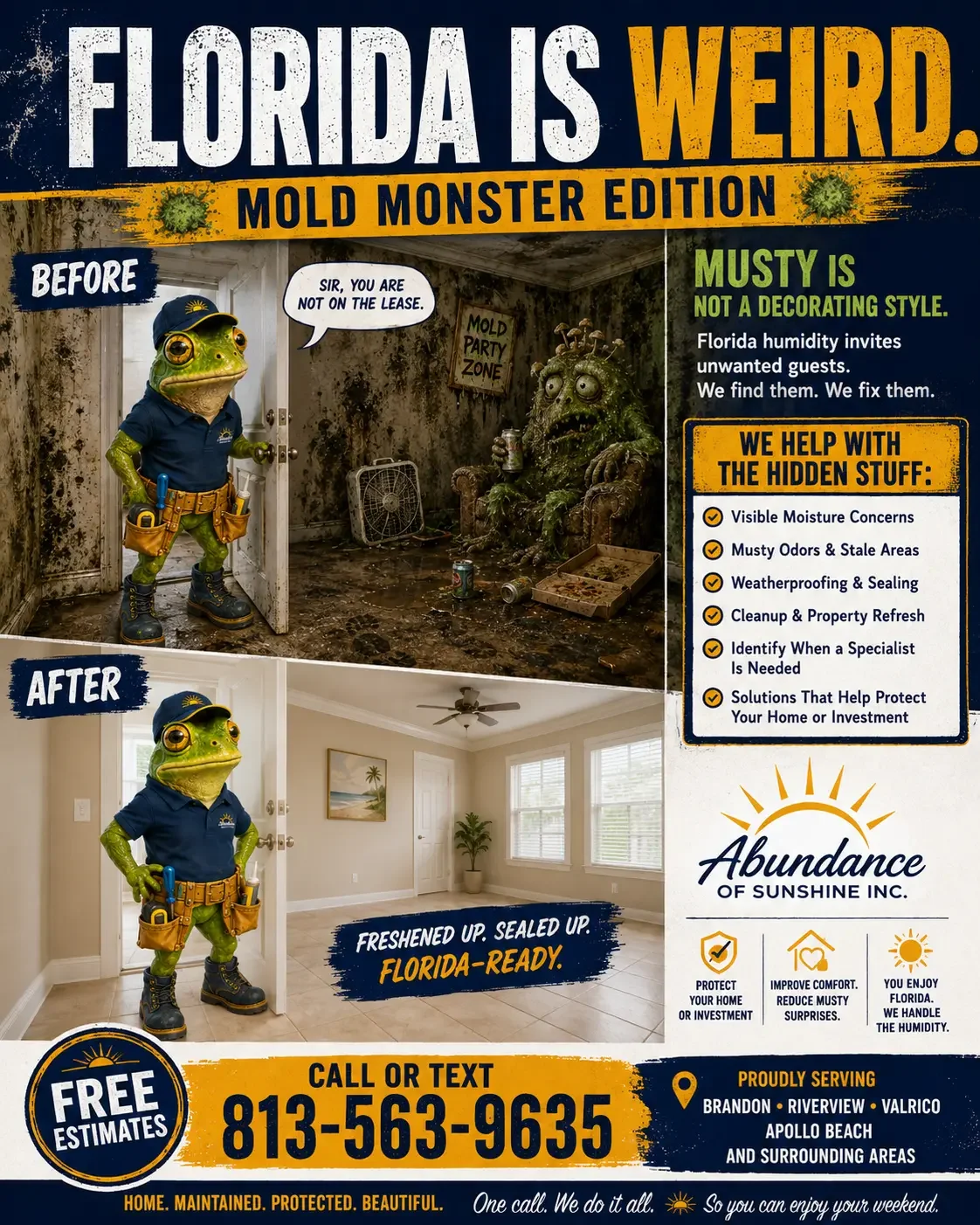
Campaign illustration for moisture awareness.
Florida homes deal with a lot of water in a lot of forms.
Rain. Humidity. Irrigation. Condensation. The occasional storm that seems personally offended by your patio furniture.
Most moisture problems do not announce themselves with a dramatic ceiling collapse. They usually start with something small enough to ignore.
A stain that keeps coming back. Caulk pulling away from a window. Trim that feels a little soft. A musty smell nobody can quite place.
And because this is Florida, waiting to see what happens is rarely the most entertaining option.
One important distinction before we start: a stain, odor or damp area does not automatically mean mold. Moisture has many possible sources, and some problems require a roofer, plumber, HVAC contractor, licensed mold professional or another specialist. The first job is simply to notice what changed and stop treating recurring moisture like part of the décor.
Here are seven signs worth a closer look.
1. A water stain that keeps returning
A stain that dries and then reappears is useful information.
Look at what is around it. Is it near a window, door, ceiling edge, plumbing fixture, exterior wall or roofline? Does it show up after heavy rain? After the air conditioner runs? After irrigation?
You do not need to diagnose the whole building from one spot. You do want to know whether the pattern is recurring.
Take a photo, note the date and pay attention to weather or other conditions when it returns. That gives you something much more useful than “I think it looked worse last week.”
2. Peeling, bubbling or discolored paint
Paint can fail for plenty of reasons, but bubbling, peeling or recurring discoloration can be a clue that moisture is getting behind the surface.
Painting over the symptom may make the wall prettier for a while. It does not answer why the surface keeps getting wet.
If moisture is involved, find and correct the source before turning it into a paint project.
3. Deteriorated caulk or visible exterior gaps
Exterior sealant does not last forever.
Check accessible areas around windows, doors, trim, penetrations and other exterior openings. Cracked, missing or separated caulk can allow ordinary rainwater to reach places it was not invited.
Routine sealing and weatherproofing can address some maintenance-level gaps. Larger leaks, damaged building components or structural concerns need the appropriate qualified professional.
4. Trim, drywall or wood that feels swollen or soft
Materials change when they stay wet.
Baseboards may swell. Wood can soften. Drywall may feel different or show staining. Doors and trim can begin sticking or changing shape.
Do not keep pressing on a questionable ceiling or wall to see how committed it is to staying attached. If the material looks unstable, keep the area clear and get the right person involved.
5. Condensation where you do not usually see it
A little condensation in the right conditions can happen. Recurring condensation on windows, walls, pipes or other surfaces deserves attention, especially if it is new.
The U.S. Environmental Protection Agency identifies moisture control as the key to controlling indoor mold growth and recommends addressing condensation and the water source quickly. EPA guidance also recommends keeping indoor relative humidity below 60 percent when possible, ideally in the 30–50 percent range.
If condensation is persistent, the cause may involve indoor humidity, ventilation, HVAC performance, insulation or another building condition. That is where guessing gets expensive.
6. A musty odor that does not go away
A musty smell is a reason to investigate, not a diagnosis by itself.
EPA guidance notes that moldy or musty odors can indicate hidden mold growth and should be investigated. But the practical question is still the same: where is the moisture coming from?
Look for obvious leaks, wet materials, damp cabinets, recurring condensation and exterior entry points you can safely inspect. If there is significant suspected mold, extensive water damage or a source you cannot identify, bring in an appropriate specialist rather than covering the smell with another air freshener and hoping everyone agrees not to discuss it.
7. Water collecting where it should be moving away
Sometimes the problem is not inside the house yet.
Watch what happens outside during a normal Florida downpour. Are gutters overflowing? Is water pooling near the structure? Are downspouts blocked? Is landscape debris interfering with drainage? Is irrigation soaking areas that are already saturated?
EPA moisture-control guidance recommends keeping gutters maintained and making sure water drains away from the building foundation.
Water is remarkably persistent. Giving it a better route is usually easier than arguing with it later.
What to do when you find moisture
If you discover an active leak or water intrusion, deal with the source as quickly as you safely can.
EPA and CDC guidance recommends drying wet or water-damaged materials quickly—generally within 24 to 48 hours when possible—to reduce the chance of mold growth.
That does not mean every homeowner should become a remediation crew over the weekend.
It means do not leave a known water problem sitting there because Monday feels more convenient.
Document what you see. Stop the water source if it is safe and within your ability. Dry accessible wet areas. Protect belongings. Then bring in the appropriate professional when the issue is beyond routine maintenance.
Where Abundance of Sunshine fits
Abundance of Sunshine can help with practical property-maintenance issues such as exterior sealing and weatherproofing, accessible caulking, screens and small property repairs, exterior cleanup, drainage-related landscape maintenance, and visual checks for obvious moisture concerns within our service scope.
We do not diagnose medical conditions, perform licensed mold remediation, replace professional roofing, plumbing, HVAC, electrical or structural services, or pretend every dark spot is mold because that makes a better Facebook post.
Sometimes the most useful answer is: this needs a specialist.
The goal is not to make every moisture issue dramatic.
It is to catch the small, fixable things before Florida gives them a bigger budget.
Need help with the maintenance side of your property?
Call Abundance of Sunshine at 813-563-9635 to discuss what you are seeing and whether it fits our service scope.
SAFETY / SERVICE-SCOPE NOTE
Abundance of Sunshine provides property-maintenance and improvement services within the company’s actual service scope. Significant water damage, suspected mold requiring remediation, roofing, plumbing, HVAC, electrical, structural issues and other licensed or specialized work should be evaluated by the appropriate qualified professional.